Guide
AI Khutbah Translation: The Complete Guide for Mosques
How mosques translate the khutbah live with AI: the tech explained, AI vs. human interpreters, how to choose a solution, GDPR, and a respectful rollout.
What you'll take away
After this guide you will be able to judge whether AI translation fits your mosque — and introduce it well, both technically and with your community.
Why khutbah translation matters now
Mosque congregations in Europe are more multilingual than ever. In the same Friday gathering you will find elders who follow the khutbah in Arabic or Turkish, young people who grew up thinking in German, English, or French, converts, refugees, and international students who bring yet other languages. A khutbah delivered in a single language genuinely reaches perhaps half the room in many communities.
What is lost goes beyond information. The khutbah is the central weekly moment of address, reminder, and community. Someone who cannot follow it is physically present but inwardly excluded — and young people and newcomers in particular quietly decide whether coming to the mosque is worth it for them. Translation is therefore not a technical gimmick; it is a question of belonging.
There is also an often-overlooked dimension: accessibility. Live captions help not only people who do not speak the imam's language, but also deaf and hard-of-hearing members of the congregation, who until now had almost no way to follow the sermon. A good translation setup opens the khutbah to several groups at once.
How AI live translation works
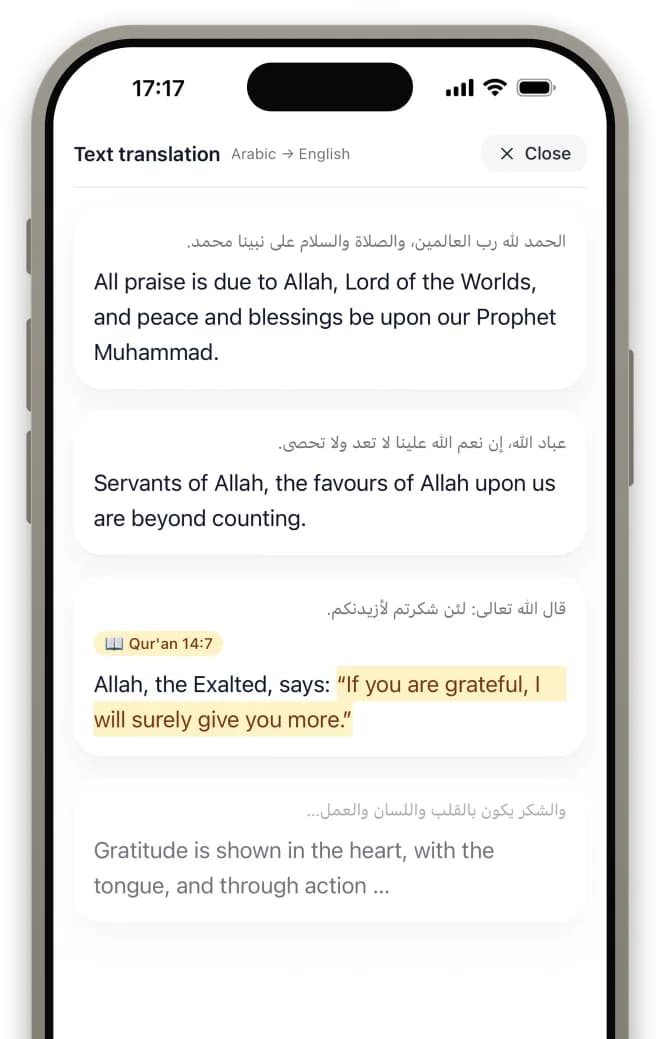
The pipeline is essentially the same across solutions and has three steps. First, speech recognition converts the imam's audio — usually taken directly from the microphone or the mosque's sound system — into text. That text is then machine-translated into the target languages. In the third step the translation is delivered: as captions and/or synthesized audio to listeners' phones, and on some platforms also to the screens inside the mosque.
For listeners, joining is deliberately simple: they scan a QR code, pick their language in the browser, and read or listen along — no app install, no account. Between the spoken word and the translation there is typically a delay of a few seconds, because the system has to wait for short units of meaning before it can translate sensibly. For a khutbah, which is not a dialogue, this barely matters in practice.
By far the biggest quality factor is the audio signal going in. AI can only translate what it hears clearly: a good, close microphone fed straight from the sound system beats any sophisticated language model struggling with room echo and background noise. If you want to invest in translation quality, invest in the signal chain first — it is usually cheaper than expected and pays off immediately.
Take the signal directly from the sound system (line-out or a dedicated microphone channel) rather than placing a phone in front of a speaker — this improves recognition quality more than any other single measure.
AI and human interpreters compared
Many communities have translated the khutbah for years with volunteer interpreters — and for good reason. An experienced human interpreter brings what no machine can: theological sensitivity, knowledge of the community, the ability to contextualize a quotation, and the judgment to render meaning rather than words when in doubt. On sensitive topics, that is invaluable.
AI has different strengths: it is available every Friday, never gets sick, needs no holidays, and translates into many languages simultaneously — including languages for which no interpreter could ever be found in the community. It is also consistent: quality does not swing with someone's form on the day, and costs are predictable. Its weaknesses lie exactly where human judgment is needed: irony, allusions, technical vocabulary, and recited texts.
In practice, the question is therefore rarely either-or. The hybrid approach combines both: AI translation as a reliable baseline across many languages, complemented by human interpreters for the most important target language or for special occasions. Platforms such as moschee.io deliberately support both — an AI mode and a workflow for human interpreters who speak to listeners through the same delivery channel.
- AI: available every Friday, many languages at once, consistent quality, predictable cost
- Human: theological precision, feel for nuance, contextualizing quotations, live judgment
- AI: weaker on irony, allusion, and recited classical Arabic
- Human: limited to one language per person, dependent on availability and form on the day
- Hybrid: AI as the baseline for many languages, human interpreters for the core language or special occasions
What to look for when choosing a solution
The market for khutbah translation is growing, and offerings differ more than their landing pages suggest. Two questions sort the field quickly: does the solution deliver both audio and caption output (older listeners often prefer audio, while younger and hearing-impaired attendees prefer to read along)? And can listeners join without installing an app — ideally via QR code straight in the browser? Every hurdle at the entrance costs you real listeners on Friday.
Next, look at the surroundings: are mosque screens supported, so captions are visible in the hall as well? Are there recordings or an archive so the khutbah can be listened to afterwards? And — non-negotiable in Europe — what about data protection? Live translation processes the imam's spoken words; GDPR compliance and EU hosting should therefore be documented, not merely claimed.
Finally, the strategic question: do you want a specialized point solution for translation only, or a platform where translation works together with livestreaming, prayer times, the website, and screens? Point tools are quicker to trial; integrated platforms such as moschee.io avoid duplicate maintenance and scattered subscriptions. In either case, insist on transparent pricing — including what happens under heavy use during Ramadan.
- Audio AND caption output for different listener groups
- No-app access: QR code, browser, no sign-up for listeners
- Mosque screen support (captions visible in the hall)
- Recordings or an archive for listening back
- GDPR compliance and EU hosting, clearly documented
- Transparent, predictable pricing — including heavy use during Ramadan
- Point solution or integrated platform (livestreaming, prayer times, website, screens)?
Do not rely on lab-condition demos: test any solution on a real Friday with your sound system, your imam, and your Wi-Fi before committing.
Introducing translation respectfully
The technology is the easy part — how you introduce it to the community decides whether it succeeds. Involve the imam from the very beginning: he should understand how the translation works, ideally have tried it himself, and stand behind the initiative. A translation introduced around the imam is rarely well received — one he mentions himself from the minbar almost always is.
Announce the change openly and set the frame: translation is an aid to understanding, not a replacement for the khutbah itself. The congregation stays together in the hall, the imam's spoken word remains the original — anyone who wishes can discreetly read along on their own phone or listen through earphones. Framing it this way defuses reservations before they arise.
Start small: with one or two languages your community actually speaks, rather than switching on the full language menu at once. After the first Fridays, gather feedback deliberately — from young people, converts, newcomers, and the volunteers running the setup — and adjust. That way the translation grows with the community rather than past it.
Put the QR code where everyone sees it: on the mosque screens and as a poster at the entrance — so even a spontaneous Friday visitor can join without having to ask.
Common pitfalls — and how to avoid them
Most disappointing experiences with AI translation share the same few causes — and almost all are avoidable. Top of the list is the microphone: a room mic five meters away, or a phone lying on the minbar, feeds the speech recognition echo and murmur instead of clear speech. Right behind it comes Wi-Fi: on Friday, hundreds of phones suddenly share the same access point, and a home router that copes fine during the week collapses exactly when it matters.
The second family of mistakes is organizational. Launching with many languages at once spreads you thin: nobody checks quality in languages no one on the team speaks. Just as risky is nobody owning the setup — the translation "just runs" until one Friday it doesn't, and no one knows whose job it is. Name one person who checks the setup before the khutbah, and a deputy.
Finally: plan for failure. Technology breaks — the only question is whether you are prepared. A simple fallback is usually enough: a short announcement, a notice that the recording with translation will be available later, or the volunteer interpreter who can step in. If you have rehearsed the outage once, you will lose neither your calm nor the community's trust on the day it happens.
- Poor microphone placement: take the signal from the sound system, not from the room
- Wi-Fi congestion on Fridays: test capacity under realistic load beforehand
- Too many languages at launch: start with one or two languages you can verify
- No clear ownership: name a responsible person plus a deputy
- No fallback plan: rehearse an outage once and keep an alternative ready
Common questions
How accurate is AI khutbah translation?
With clear speech and a good audio signal, translation today is good enough to follow a khutbah reliably in substance. Quality depends mainly on three factors: the audio quality at the microphone, the clarity of delivery, and the language pair. Individual terms or quotations can be rendered imprecisely — which is why the translation should be treated as an aid to understanding, not an authoritative rendering. A test under real conditions tells you more than any spec sheet.
Do listeners need to install an app?
With most modern solutions, no — and this should be one of your selection criteria. Listeners scan a QR code and open the translation directly in the browser, with no installation and no account. This matters, because on Friday even spontaneous guests, elderly members, and first-time visitors need to get in within seconds. With moschee.io, for example, access works entirely via QR code and browser.
Can AI translation handle Quran recitation?
Yes, with limits. Recited classical Arabic is significantly harder to recognize than everyday speech, because melody, elongation, and tajwid rules change the sound. Good tools therefore detect recited verses and, instead of a free machine translation, show a published Quran translation with the surah and ayah reference. moschee.io does this automatically: recognized verses appear in an established translation — Saheeh International for English, for example — where one exists for the target language; otherwise the AI rendering is labeled as such. No detection is perfect, so when in doubt, check the verse against a vetted Quran translation.
What does AI khutbah translation cost?
The range is wide: from free basic tools with tight limits, through specialized point solutions typically in the region of $99–299 per month, to platforms that bundle translation into a package with livestreaming, website, and screens. With moschee.io, live translation is included from the Basis plan, which you can try free for 14 days. moschee.io pricing: Gebetszeiten free; Basis €99 per month (€89 per month billed yearly); Gemeinde Plus €199 per month (€179 per month billed yearly); Reichweite €499 per month (€449 per month billed yearly). Either way, calculate the total cost: a cheap point tool plus separate subscriptions for website and streaming often ends up more expensive than a bundle.
Is it appropriate to translate the khutbah live?
The question of which language the khutbah itself is delivered in is answered differently across schools of law and communities — that decision rests with your imam and your community. An accompanying translation for better understanding is a separate matter: it does not replace the khutbah, but helps those present follow it — comparable to the long-standing practice in many communities of summarizing the sermon afterwards or in parallel. In this form it is expressly welcomed in most communities. When in doubt, talk to your imam before you start.
Put it into practice today
moschee.io includes prayer times, a website, an app, livestreaming, and AI translation. Prayer times are free; everything else starts with the Basis plan — try it free for 14 days.
Keep reading
How to Live-Translate the Khutbah (Friday Sermon): Step-by-Step Guide
Read guide →Mosque Livestreaming Setup: The Practical Guide
Read guide →