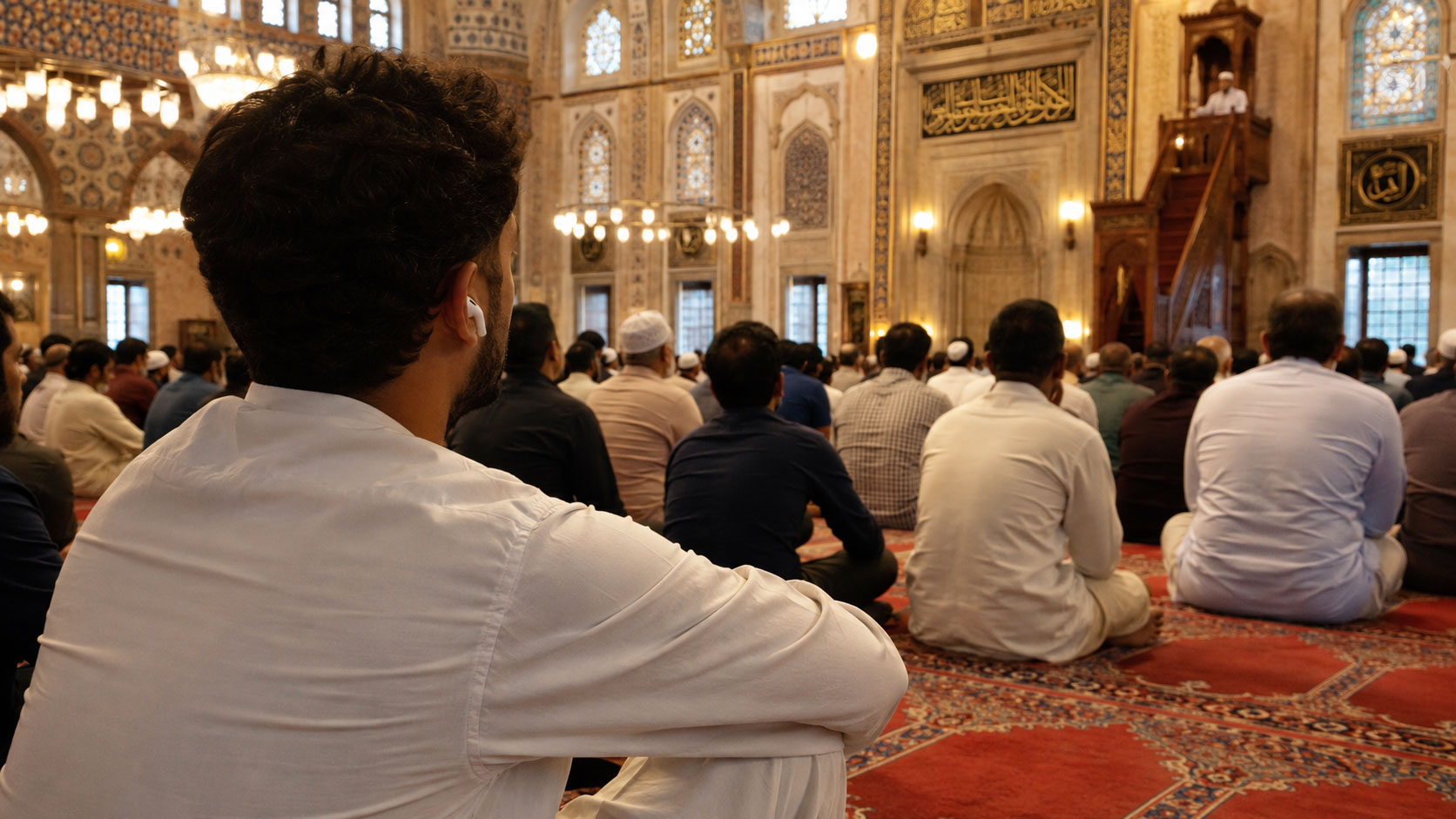
Walk into almost any mosque on a Friday and you will find the same quiet problem. The khutbah is given in one language, but the people listening speak many. A convert who joined last month, a student from abroad, a grandmother who never learned the local tongue, a guest who wandered in for the first time. They are all in the room, and parts of the message pass them by.
Mosques have tried to solve this for years. Some split the sermon into two languages and run long. Some bought FM transmitters and handed out little receivers at the door. A few invested in expensive headset systems. Each of these works, sort of, and each comes with cost, hardware and someone to run it every single week.
Today we are shipping something different. moschee.io can now translate your livestream into other languages in real time, while the imam is still speaking. No receivers to hand out, no second sermon, no booth. Just a language each listener picks for themselves.
It is live in beta inside your existing livestream rooms right now.
See it for yourself
Here is a small, self-contained version of what a listener sees. Press play, then switch languages while it runs. Notice how every caption re-renders into the language you choose, the same way each person in your community can follow their own lane.
Pick your language
Press play to hear the khutbah arrive in English, sentence by sentence, the moment it is spoken.
This is a scripted preview, not a live stream, but the behaviour is the real thing: the original Arabic on top, the translation arriving sentence by sentence underneath, and a Qur'an verse that gets recognised and shown from a published translation rather than guessed at.
What "real time" actually means here
When people hear "AI translation" they often picture uploading a recording and waiting for a file. This is the opposite. The translation happens continuously, in the same breath as the speaker.
Here is the path a single sentence takes, start to finish, while the talk keeps going.
Capture
The imam's microphone, your camera or NDI feed.
Transcribe
Speech becomes text in the original language, live.
Translate
Each target language is produced in parallel.
Voice + text
A natural voice and read-along captions per lane.
Listener
Everyone picks their own language and follows along.
Every step happens continuously while the imam is still speaking. No pauses, no two-part sermons.
Because every stage runs continuously, a listener who picks German hears German a moment after the words are spoken, and a listener who picks Turkish hears Turkish at the same time. Nobody waits for the sermon to end. Nobody gets a second, shorter version of the talk.
Listen, or read, or both
Not everyone wants audio. Someone sitting in the prayer hall may prefer to read quietly. Someone with hearing difficulties may rely on text entirely. Someone following from home might want both.
So every language lane comes two ways:
- A spoken voice. A natural-sounding translation the listener hears through their own headphones.
- Live captions. The same translation as text, scrolling along in real time, so people can read at their own pace and scroll back if they missed a line.
The listener flips between them with one tap. It is the same translation either way, just delivered in whichever form suits them.
Qur'an verses are handled with care
This is the part we are most careful about, and the part we are most proud of.
When an imam recites a verse from the Qur'an, a loose machine translation is not good enough. The words carry weight, and people know them. So the system listens for recitation, recognises the verse, and instead of paraphrasing it on the fly, it shows the original Arabic alongside an established, published translation.
You choose which translation each language uses. For German you might pick Bubenheim & Elyas. For English, Saheeh International or Yusuf Ali. For French, Hamidullah. For Turkish, a Diyanet edition. The verse appears clearly marked, with its surah and ayah reference, so no one mistakes a sermon's wording for the words of the Qur'an itself.
In the demo above, watch for the verse from Surah Al-ʿAsr. It arrives with a small badge naming the surah and the edition, and the text switches to the official translation for whichever language you picked.
Many languages, at the same time
A human interpreter can only translate into one language at a time. That is the real ceiling on the old approach. You either pick the one language most of your guests share, or you run several interpreters, which almost no mosque can staff.
The live translator does not have that limit. Turn on the languages your community actually needs, and every one of them runs at once. Each listener picks theirs on the public room page and the rest stay out of their way.
14 languages today, with more added over time. Each listener chooses one independently.
You will not switch all of these on at once, and you should not. Pick the handful that match your congregation. But the headroom is there for the mosque with a genuinely mixed community, and for the one-off event with guests from everywhere.
The old way, and the new way
If your mosque already handles translation somehow, here is an honest comparison of where this lands.
- SetupFM transmitters, receivers, a booth and a rota of interpreters.
- LanguagesOne interpreter, one language at a time.
- CostHardware, batteries and people for every single talk.
- What people needBorrowed receivers that run out or go missing.
- Qur'an versesParaphrased live, quality depends on the interpreter.
- SetupA toggle in your existing livestream room.
- LanguagesMany languages at once, each listener picks their own.
- CostIncluded in your plan, nothing to hand out.
- What people needThe phone and headphones already in their pocket.
- Qur'an versesRecognised and shown from a published translation.
We are not claiming a machine matches a gifted human interpreter who knows your community and your imam's style. For the most important talks, many mosques will still want a person in the loop, and moschee.io supports a human interpreter path too. What live AI translation changes is the baseline. Every other talk, every lecture, every visitor who shows up speaking a language you had no interpreter for, now has a way in.
Who this is for
A few situations where mosques tell us this matters most:
- Mixed communities. A congregation that prays together but grew up speaking four or five different languages.
- New Muslims and guests. People early in their journey, or visiting for the first time, who would otherwise sit through a talk they cannot follow.
- Students and travellers. Anyone living far from home who wants to keep attending without the language barrier.
- Open days and big events. Occasions where you expect visitors from outside the community and want the message to reach all of them.
- Accessibility. Members who rely on reading along rather than listening.
Turning it on
If your mosque already livestreams with moschee.io, you are most of the way there. Inside a livestream room:
- Open the Translator section in your stream setup.
- Switch it on, and choose the source language the talk is given in.
- Pick the target languages your community needs.
- Choose the source audio, the imam's microphone, your camera feed or an NDI input.
- Go live as you normally would.
Listeners then see a translation card on the public room page and in the mobile app. They pick a language, choose listen or read, and follow along. Lanes start on demand, so you are not running languages nobody selected.
A note on the beta
Live AI translation is launching as a beta. It is genuinely useful today, and it is also young. You may hear the occasional awkward phrasing, and very fast or overlapping speech is harder for any system, human or machine. We are improving it continuously, and because moschee.io updates itself, every improvement reaches your mosque automatically, with no update to install and no extra cost on your plan.
If you try it, we would genuinely like to hear how it went, what worked, what did not, and which languages your community reached for.
Frequently asked questions
Does the translation happen live, or after the talk? Live. Captions and translated audio arrive while the speaker is still talking, not after the recording ends.
How many languages can run at once? As many as you turn on. Each listener selects one for themselves on the public page or in the app. Fourteen languages are available today, with more over time.
How are Qur'an verses handled? Recited verses are recognised and shown from a published translation you choose per language, alongside the original Arabic, rather than being paraphrased by a machine.
Do listeners need to install anything or borrow a receiver? No. They use the phone and headphones they already carry. They watch in the browser or the moschee.io app and pick their language. There is no hardware to hand out.
Can we still use a human interpreter? Yes. The human interpreter path is still there. Many mosques will use AI translation for everyday talks and a person for the most important ones.
Does it cost extra? Live translation is part of the platform. As with every feature we ship, you get it automatically, with no separate charge.
Reach everyone who walks in
A mosque is for the whole community, including the people who do not yet share its main language. Live translation is a step toward a simple idea: that anyone who comes through the door can understand what is being said, in the language they think in, without anyone having to set up special equipment first.
It is live now, in beta, inside your livestream rooms.
moschee.io, the platform for modern mosques.